

About our technology
The Spectro inlets EC-MS system is a unique instrument for high-sensitivity time-resolved detection of volatile electrochemistry products directly from a liquid electrolyte. Notably, this instrument is optimized for half-cell investigations, i.e., it allows the user to decouple the evolution of volatile products and consumption of reactants at the working and counter electrodes during electrochemical reactions.
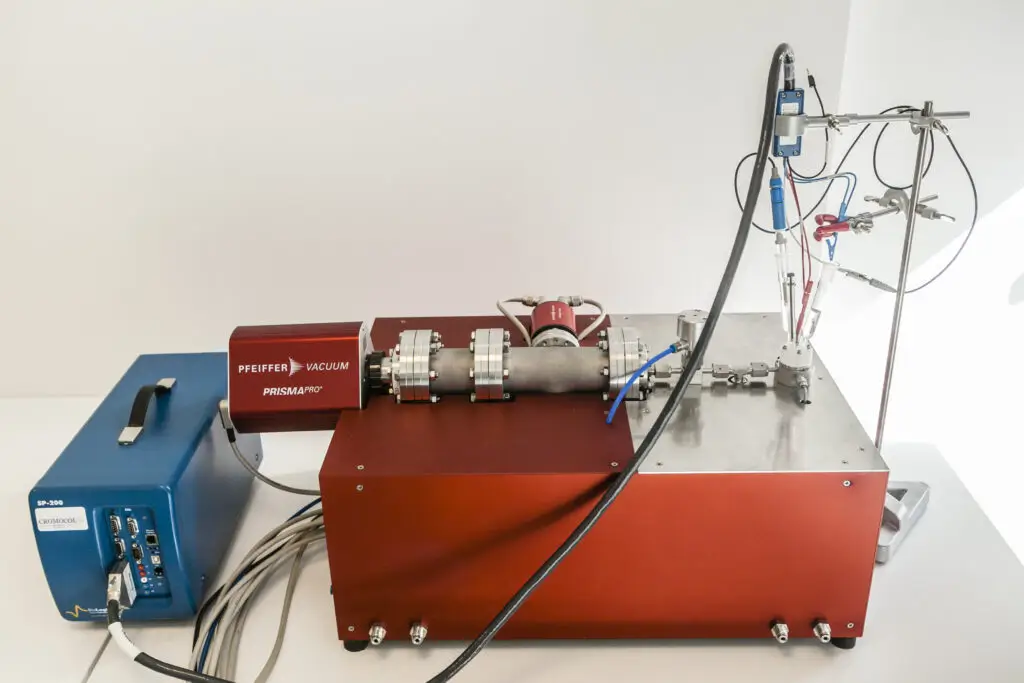
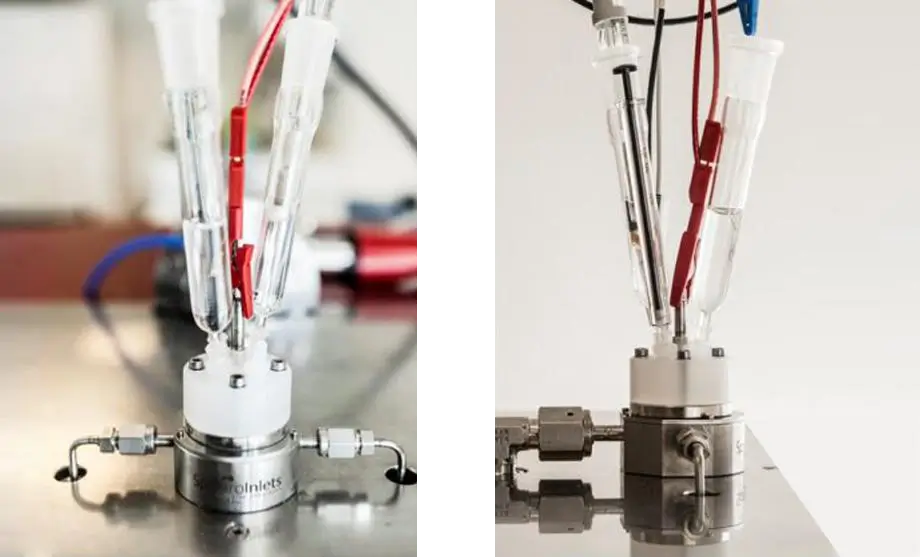
The image shows that the compact instrument fits comfortably on standard laboratory tables. Moreover, it operates straight out of the package upon installation with the embedded, fully functional 3-electrode EC cell and Bio-Logic SP-200 potentiostat.
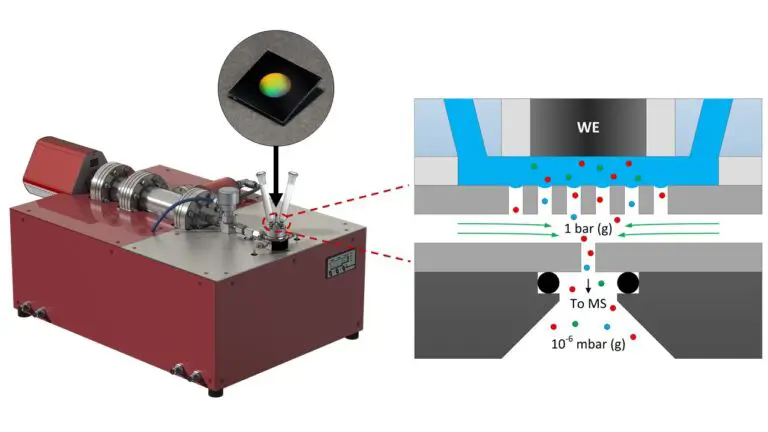
Working principle of the membrane chip
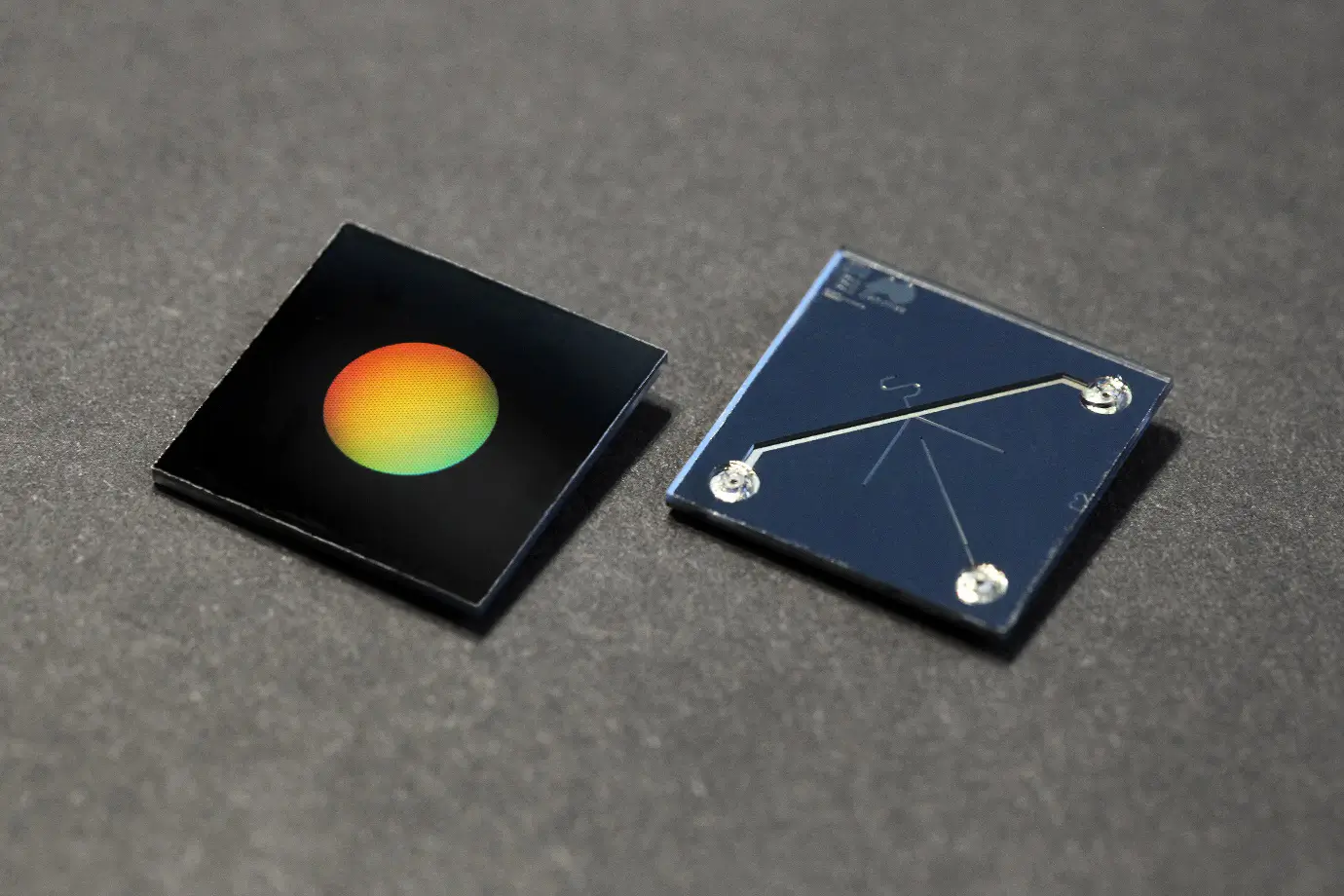
The membrane chip creates a direct coupling between the electrolyte and the high vacuum of a mass spectrometer (MS) without differential pumping.
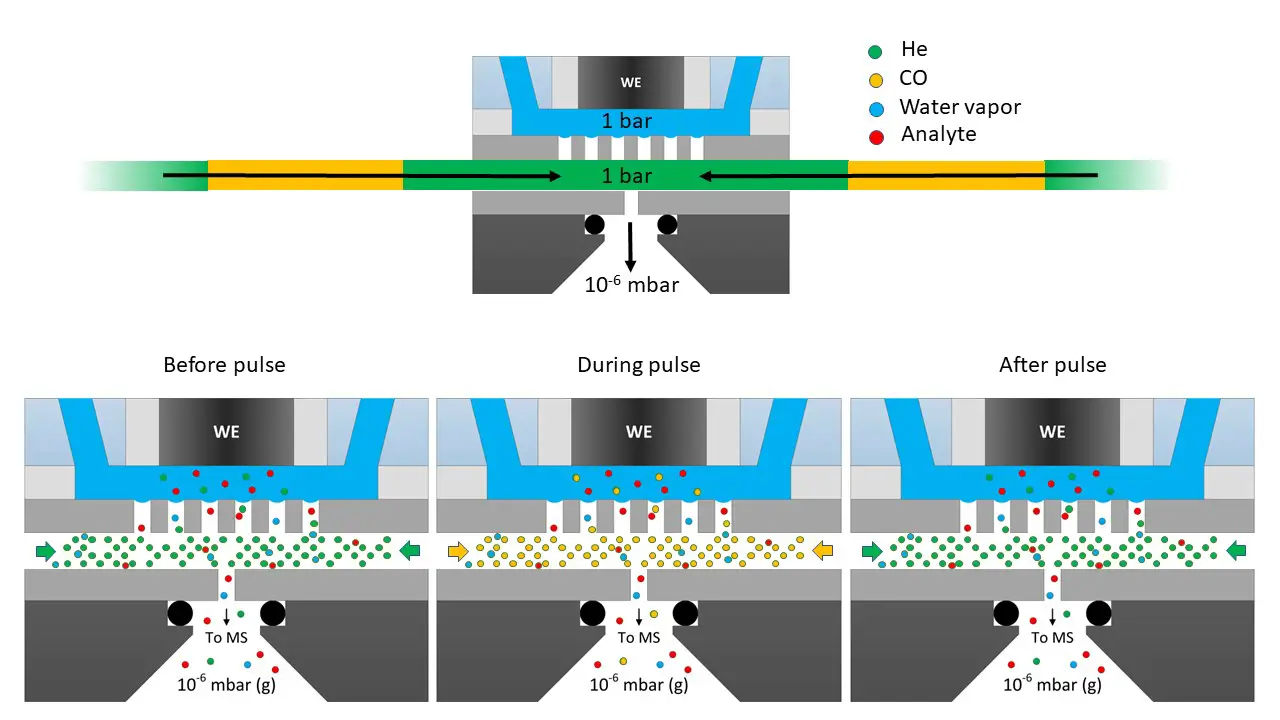
The membrane chip creates a well-defined liquid-gas-vacuum interface and controls the transfer of volatile molecules from the electrolyte to the mass spectrometer. Inside the chip, a buried sampling volume equilibrates to the outer environment without letting liquid in. The pressure in the sampling volume is precisely controlled by our embedded gas handling system.
To pressurize the sampling volume, any make-up gas can be used. Owing to the small size of the sampling volume and of the electrolyte layer, equilibration between the gas and the liquid is nearly instantaneous. During equilibration, all volatile species in the liquid fill the sampling volume based on Henry’s law. The sampling volume is connected to the MS by a capillary designed to limit the flow of molecules to exactly 1015 molecules/sec. No differential pumping stage is thus necessary. Because the flow is known and all the molecules are collected by the MS, direct conversion of the mass spectrometry signal to mol/sec is possible. This makes the Spectro Inlets the only existing truly quantitative EC-MS system. Finally, the pressurization of the sampling volume allows EC experiments at elevated pressures and temperatures.
Standardized sample holder
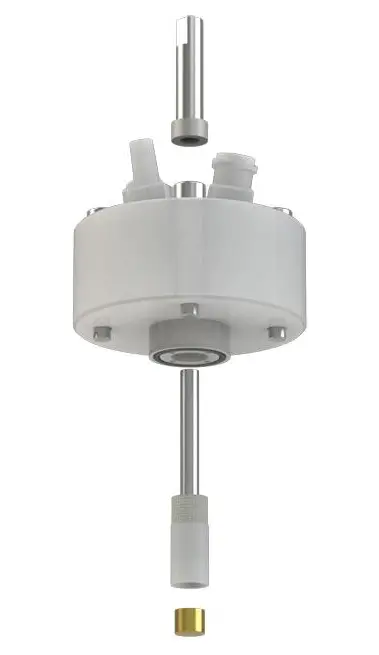
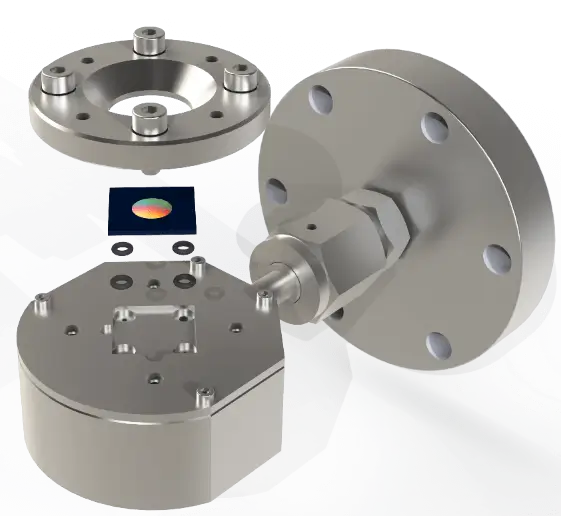
Electrode assembly, with a disk contact core assembly from Pine Research used to retain the working electrode in the EC cell.
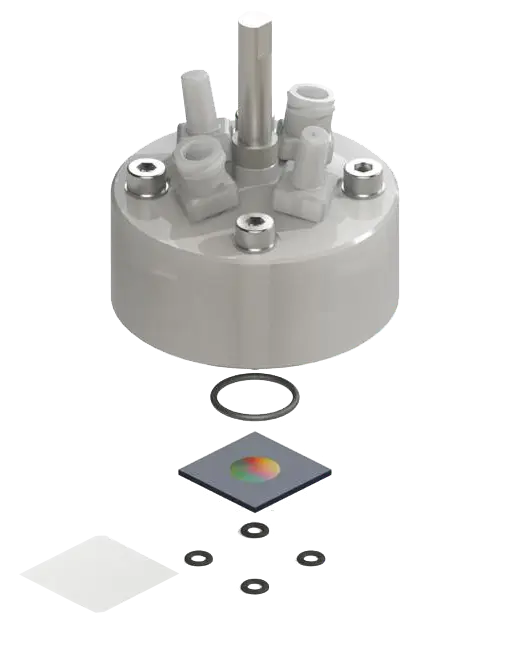
Mounting of cell onto membrane chip
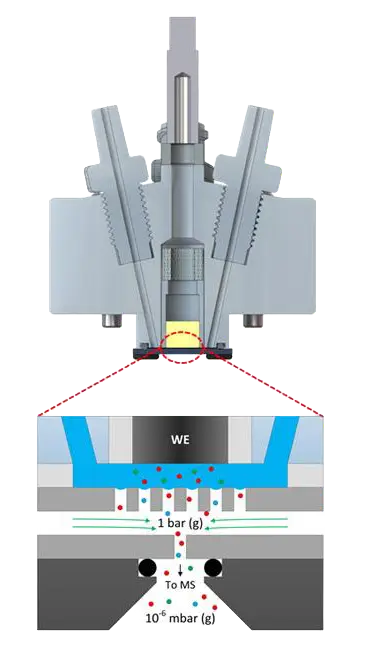
Cross sectional view of the assembled flow cell.
Because of the extraordinary control of experimental parameters obtained by microchip design, the transport mechanisms of species from the electrode surface through the electrolyte and to the sampling volume are fully defined and modeled (Trimarco et al. Electrochim. Acta).
The thin-layer cell is designed to transfer and quantify all volatile molecules that evolve at the electrode surface to the mass spectrometer. This is a truly unique characteristic of the Spectro Inlets system, and it allows to obtain, e.g., the data shown in CO-stripping.
The cell can also be operated in flow mode.
Fast time response
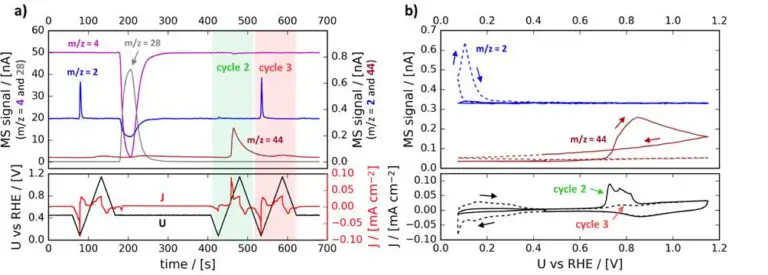
Figure 1.
High sensitivity and dynamic range
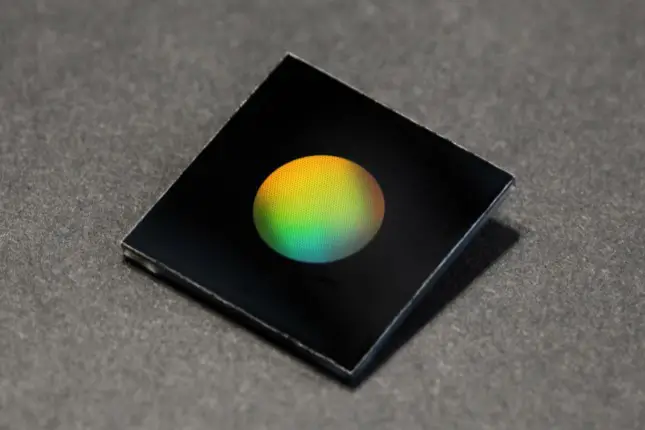
Membrane chip was chosen to optimize the collection efficiency for molecules with high volatility and those which occur most often in electrochemical experiments.
Quantitative analysis
With a 7-orders-of-magnitude dynamic range, the Spectro Inlets system can operate with gases with a 6.0 purity level. Furthermore, the entire system is constructed using VCR® metal gasket face seal components, rated for ultrahigh vacuum applications, and compatible with 6.0 gases.
Dosing of reactant gases
Fast sample and chip exchange
The system contains an integrated vacuum system controlled by pneumatic valves via the user-friendly graphical user interface. Additionally, the system allows for rapid chip exchange with an automated pump-down procedure. A new chip can be installed in a few minutes without stopping pumps or turning off the spectrometer. This allows the user to dedicate different chips for experiments in special electrolytes or different electrode materials and switch between experiments in minutes.
If the system did not have an optimized, integrated vacuum system, the entire chamber would have to be vented every time a new sample or chip was exchanged. Not only is this a very time-consuming process, but it also dramatically compromises the vacuum quality in the MS chamber, increasing the baseline floor of the mass spectrum reading and, ultimately, compromising the high sensitivity of the instrument. Furthermore, venting requires the ionization filament of the mass spectrometer to be turned off, which is harmful and undesirable for multiple reasons.
First, frequent power cycles of the filament shorten its lifetime. Second, degassing occurs each time the filament is turned on, deteriorating the vacuum level and wasting time.
Streamlined Software Solution
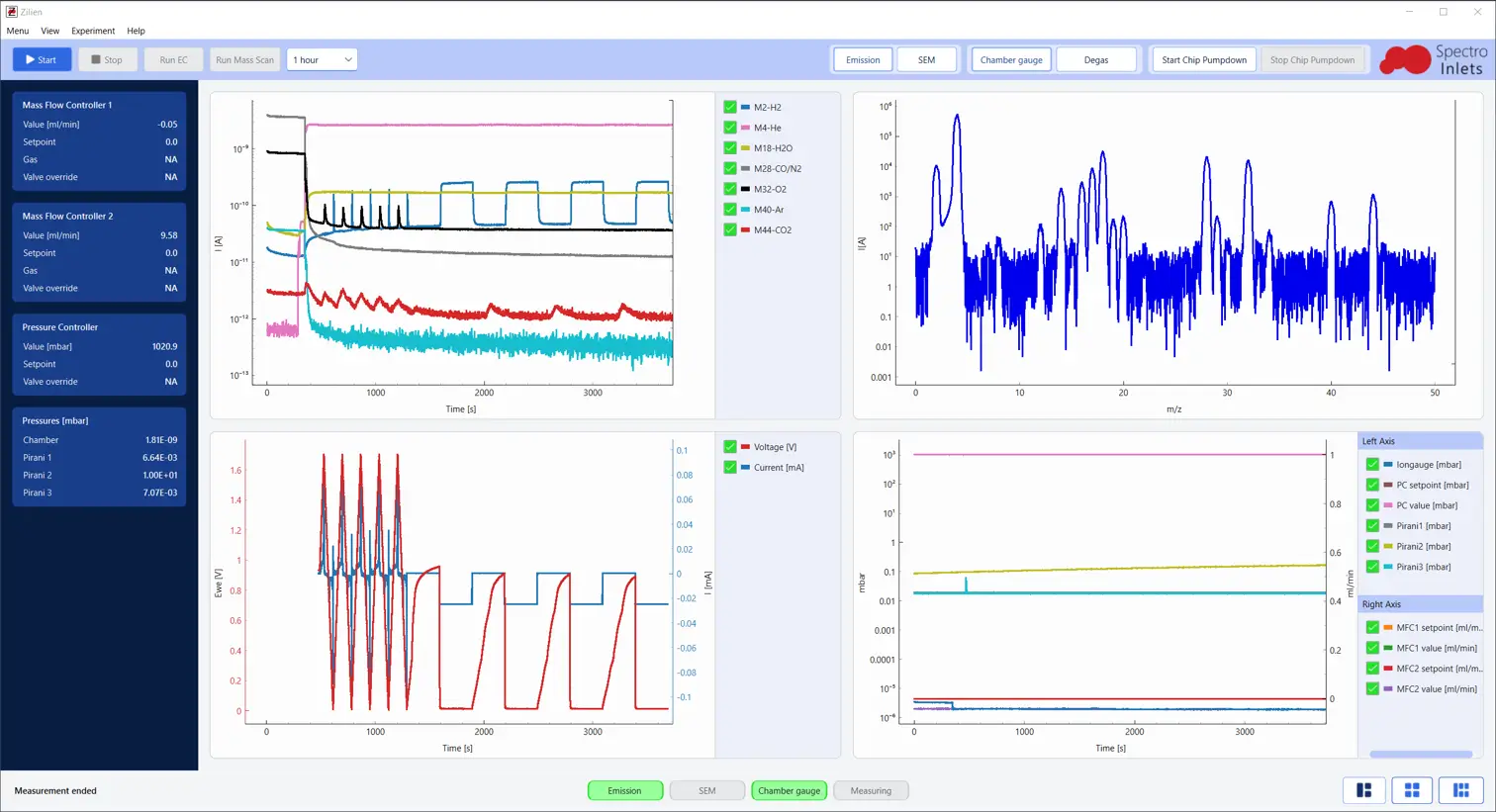
We developed the Spectro Inlets EC-MS system in collaboration with Bio-Logic, so users can use the familiar EC-Lab software at its full capability to control EC experiments. The Spectro Inlets software directly communicates with EC-Lab and makes all the plots available inside the graphical user interface, together with the MS data.
The software allows the complete overview and control of the system with a user-friendly graphical user interface. Pneumatic valves, vacuum system, electronics, gas inlet system, and data acquisition are controlled via this interface. The user can manually control the individual components or use the convenient automated procedures, e.g., chip pump-down, timed gas pulsing, gas exchange, gas flow control, pressure control, etc.
The software streamlines synchronous acquisition, display, and storage of electrochemistry and mass spectrometry data with sub-second time resolution. The EC and MS data are acquired simultaneously, displayed side-by-side, and exported in a single ASCII text file, pre-synchronized. The file format is simple and well documented, helping with data analysis after experiments.
Automation enables the freedom to concentrate on electrochemistry and obtain reproducible, standardized results. The software is developed in LabView, and it is open source. Our users are free and encouraged to modify the software and tailor the interface to their needs.