

Gas Pulses in the EC-MS Gas Exchange System
EC-MS Technical notes #1
- Last updated

As an application example of the gas exchange system, this section will describe how gas pulses can be sent to the sample. In Figure 1, a plot of two Ar gas pulses is shown. In order to minimize switching time, a few tricks are described in the following.
The described procedure assumes that He is flowing in MFC2, and that line #1 is prepared as described in the user manual, i.e. a second gas (e.g. Ar in the present example) is connected to the EC‐MS and the tubing has been evacuated and re‐filled with gas.
- Go to main tab in Zilien.
- Set MFC2 flow to 1 mL/min.
- Set MFC1 flow to 10 mL/min but do not press enter or click outside of the setpoint field yet.
- Click on V8 to switch gas line. Clicking on V8 simultaneously activates the new flow setting on MFC1.
- Set MFC2 flow to 0 mL/min. It is important to always remember to set the flow to 0 to avoid gas build‐up between MFC2 and V8.
- Wait until the desired purity is achieved.
- As shown in Figure 1, when switching from He to Ar, it takes approximately 20 seconds for the M4 signal to drop by two orders of magnitude.
- When switching from Ar to He, it takes approximately 50 seconds for the M40 signal to drop by two orders of magnitude.
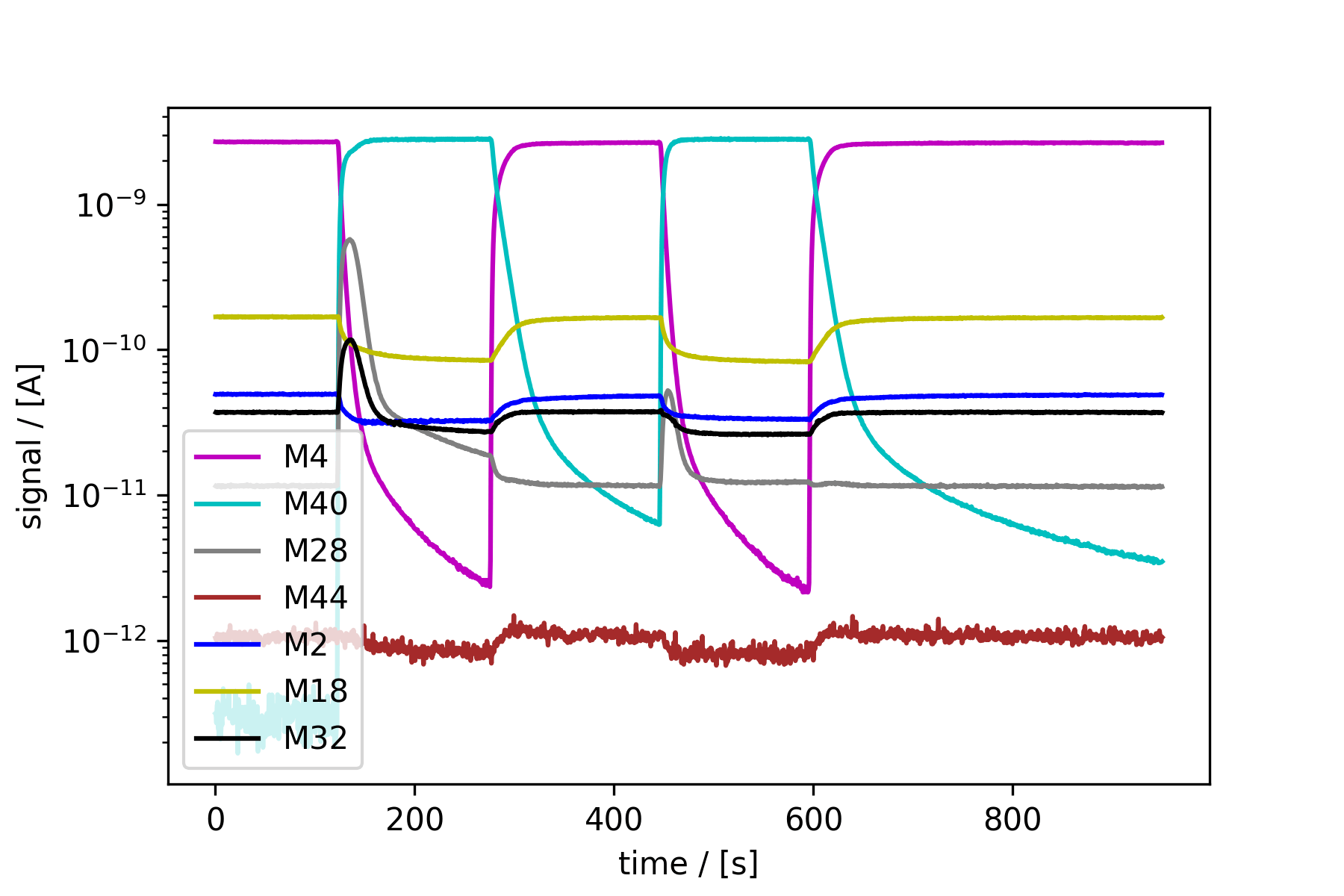
Argon (M40) gas pulses sent via the gas exchange system to the sample quickly replacing He (M4). EC‐cell mounted and filled with 0.1 M aqueous perchloric acid electrolyte. When switching to Ar, initially, also air signals M28 and M32 increase, as a small amount of air was trapped between V8 and the chip. This can be avoided by preparing the line according to the manual directly before performing the gas exchange.
The membrane chip creates a direct coupling between the electrolyte and the high vacuum of a mass spectrometer (MS) without differential pumping.
The membrane chip creates a well-defined liquid-gas-vacuum interface and controls the transfer of volatile molecules from the electrolyte to the mass spectrometer. Inside the chip, a buried sampling volume equilibrates to the outer environment without letting liquid in. The pressure in the sampling volume is precisely controlled by our embedded gas handling system.
To pressurize the sampling volume, any make-up gas can be used. Owing to the small size of the sampling volume and of the electrolyte layer, equilibration between the gas and the liquid is nearly instantaneous. During equilibration, all volatile species in the liquid fill the sampling volume based on Henry’s law. The sampling volume is connected to the MS by a capillary designed to limit the flow of molecules to exactly 1015 molecules/sec. No differential pumping stage is thus necessary. Because the flow is known and all the molecules are collected by the MS, direct conversion of the mass spectrometry signal to mol/sec is possible. This makes the Spectro Inlets the only existing truly quantitative EC-MS system. Finally, the pressurization of the sampling volume allows EC experiments at elevated pressures and temperatures.