
Carbon-nitrogen bond formation on Cu electrodes during CO2 reduction in NO3- solution
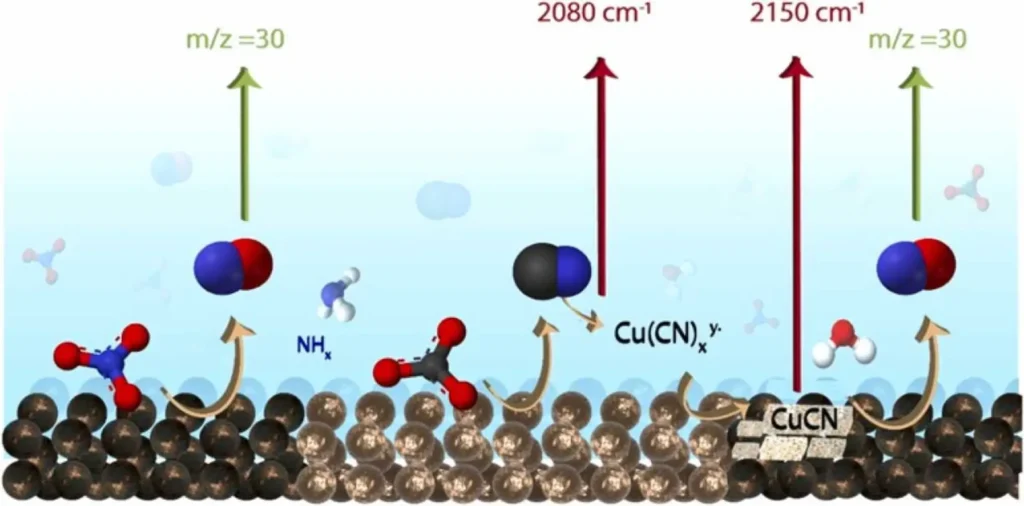
Raman spectroscopy reveals that co-reduction of NO₃⁻ and CO₂ on Cu forms Cu-C≡N–like species — soluble intermediates that drive significant surface restructuring and yield NO upon oxidation. The species appear to originate from Cu-CO and Cu-NHx intermediates, with implications for electrochemical C-N bond formation toward urea, amines, and amides.
Tuning of the QMS
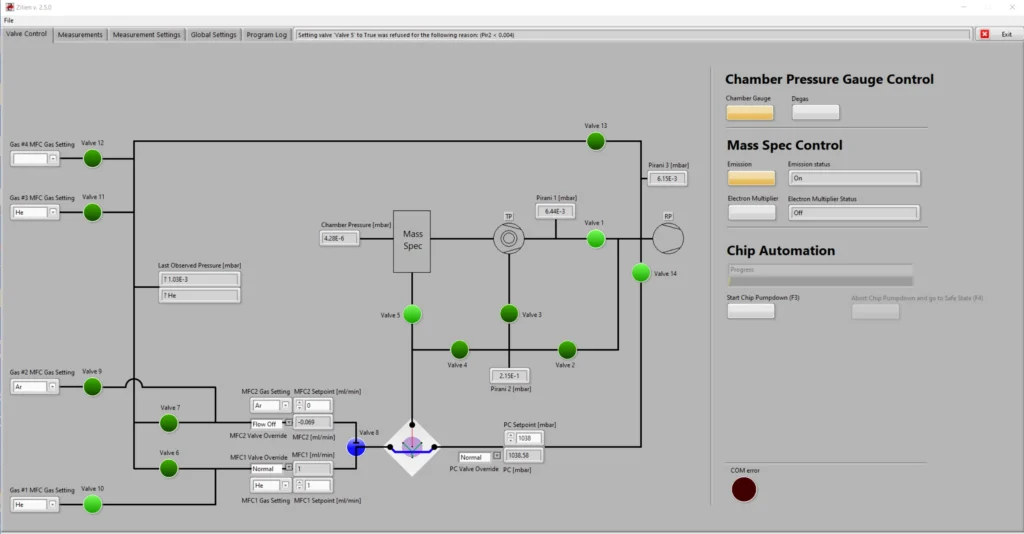
EC-MS Technical Note #5: step-by-step QMS peak and EM voltage tuning in PV MassSpec, with signal examples from a well-tuned system.
Quantification of Hydride Coverage on Cu(111) by Electrochemical Mass Spectrometry
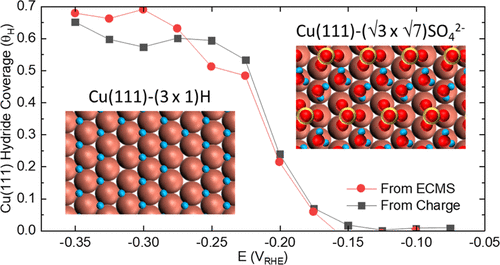
EC-MS combined with chronoamperometry quantifies the Cu(111) surface hydride phase in H₂SO₄, tracking H₂ production to partition reduction current between anion desorption, hydride formation, and HER. Saturated hydride coverage of 0.67 is established, with thin-layer cell geometry enabling total H₂ collection to overcome diffusional delay in the EC-MS response.
Best practices using EC‐MS system for HER
EC-MS Technical Note #5: step-by-step QMS peak and EM voltage tuning in PV MassSpec, with signal examples from a well-tuned system.
Best practices for OER experiments
EC-MS Technical Note #5: step-by-step QMS peak and EM voltage tuning in PV MassSpec, with signal examples from a well-tuned system.
Benchmark Measurements
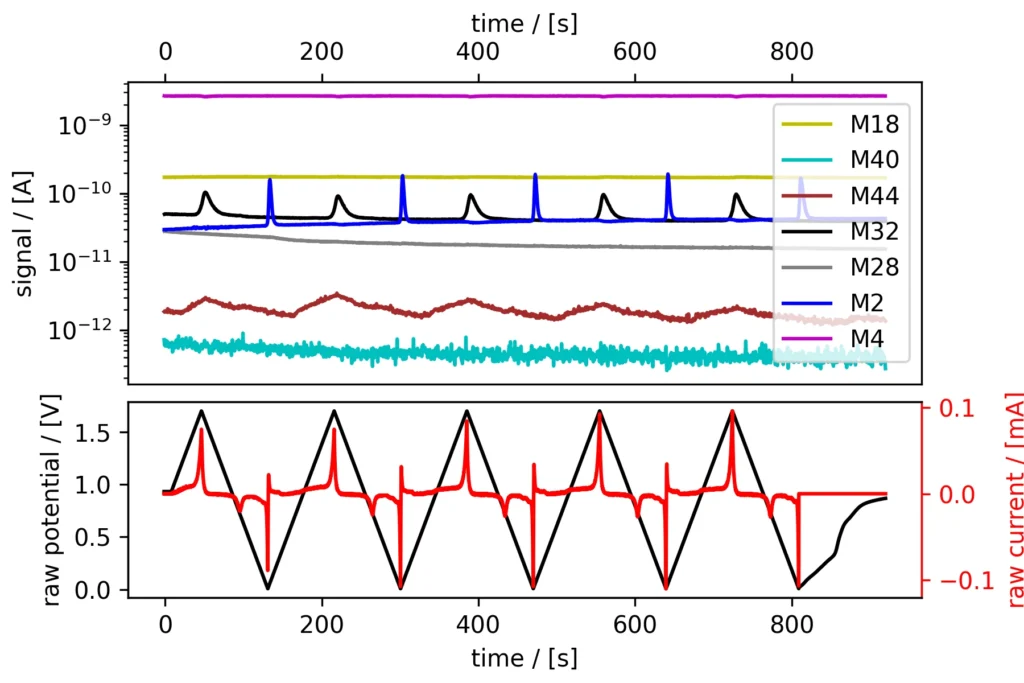
EC-MS Technical Note #2: standardized cyclic voltammetry and chronopotentiometry benchmark measurements on Pt-Poly and GC electrodes, with expected M2 decay half-lives.
Potentiostat instability
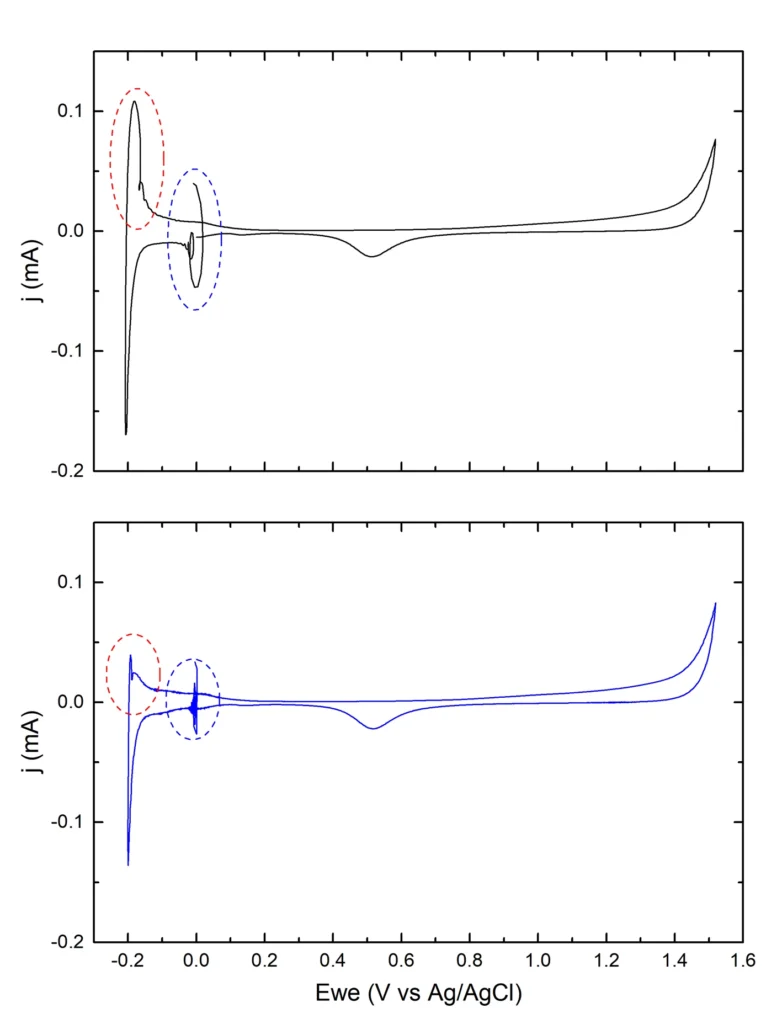
EC-MS Technical Note #3: how capacitive EC-cells cause potentiostat instability in CV measurements, and how to fix it with a series resistor and post-measurement iR compensation.
Air‐free transfer from a glovebox
Standardize your EC-MS setup with reproducible benchmark measurements on Pt-Poly and glassy carbon electrodes. Covers cyclic voltammetry and chronopotentiometry procedures for HER and OER, plus M2 signal decay analysis to gauge system cleanliness and tuning status.
Rational Catalyst Design for Higher Propene Partial Electro-oxidation Activity by Alloying Pd with Au
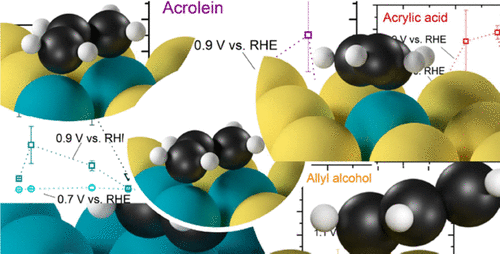
Alloying Pd with 10% Au disrupts the inhibiting adsorbate layer that limits propene oxidation on pure Pd, delivering a 2.4× activity boost while maintaining high allyl oxidation selectivity. Statistical modelling and EC-MS point to an optimal surface ratio of ~1 Au per 6 Pd atoms, with peak activity just below Pd cluster oxidation potential.
Gas Pulses
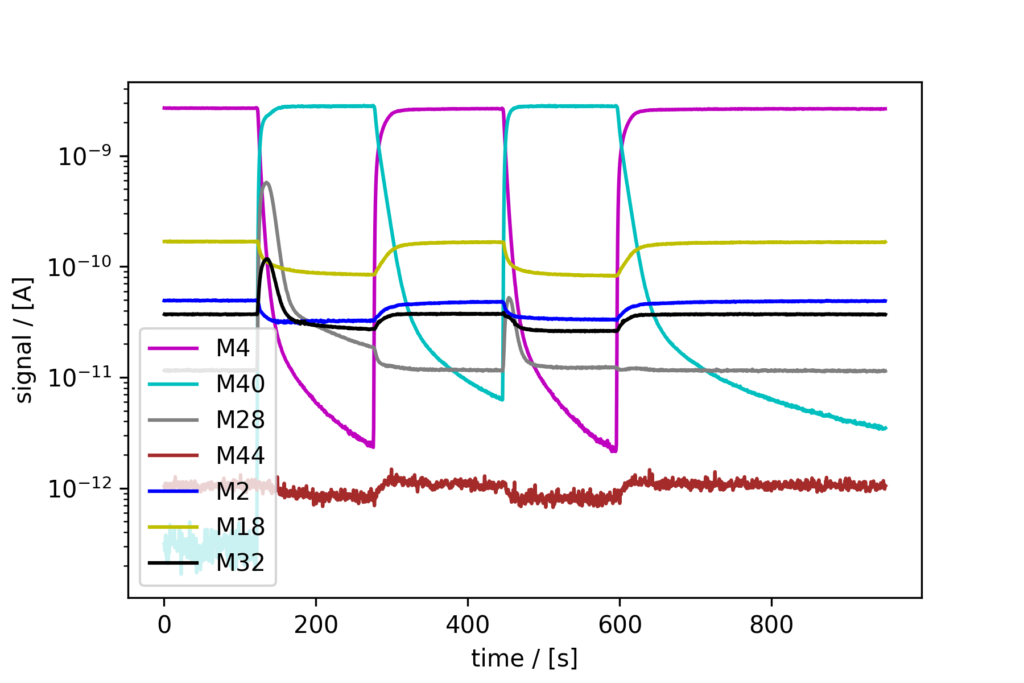
Learn how to send Ar and He gas pulses through the EC-MS gas exchange system with minimal switching time. Covers the step-by-step MFC and valve sequence, plus expected switching times — roughly 20 seconds from He to Ar, and 50 seconds from Ar to He.